AI pays in a small business when it takes over repetitive work that follows clear rules and that a person checks: follow ups, reminders, first drafts, summaries and data entry. It costs you when it replaces what customers pay you for: your judgment, your voice and the final answer. Most businesses that get nothing from AI didn’t pick the wrong tool. They put it in the wrong place.
Why do most AI projects fail to make money?
Because they start where AI is most visible, not where it saves the most. For its 2025 report, The GenAI Divide, MIT’s NANDA initiative reviewed 300 public AI deployments, interviewed 150 leaders and surveyed 350 employees. About 95% of generative AI pilots showed little to no measurable impact on profit and loss.
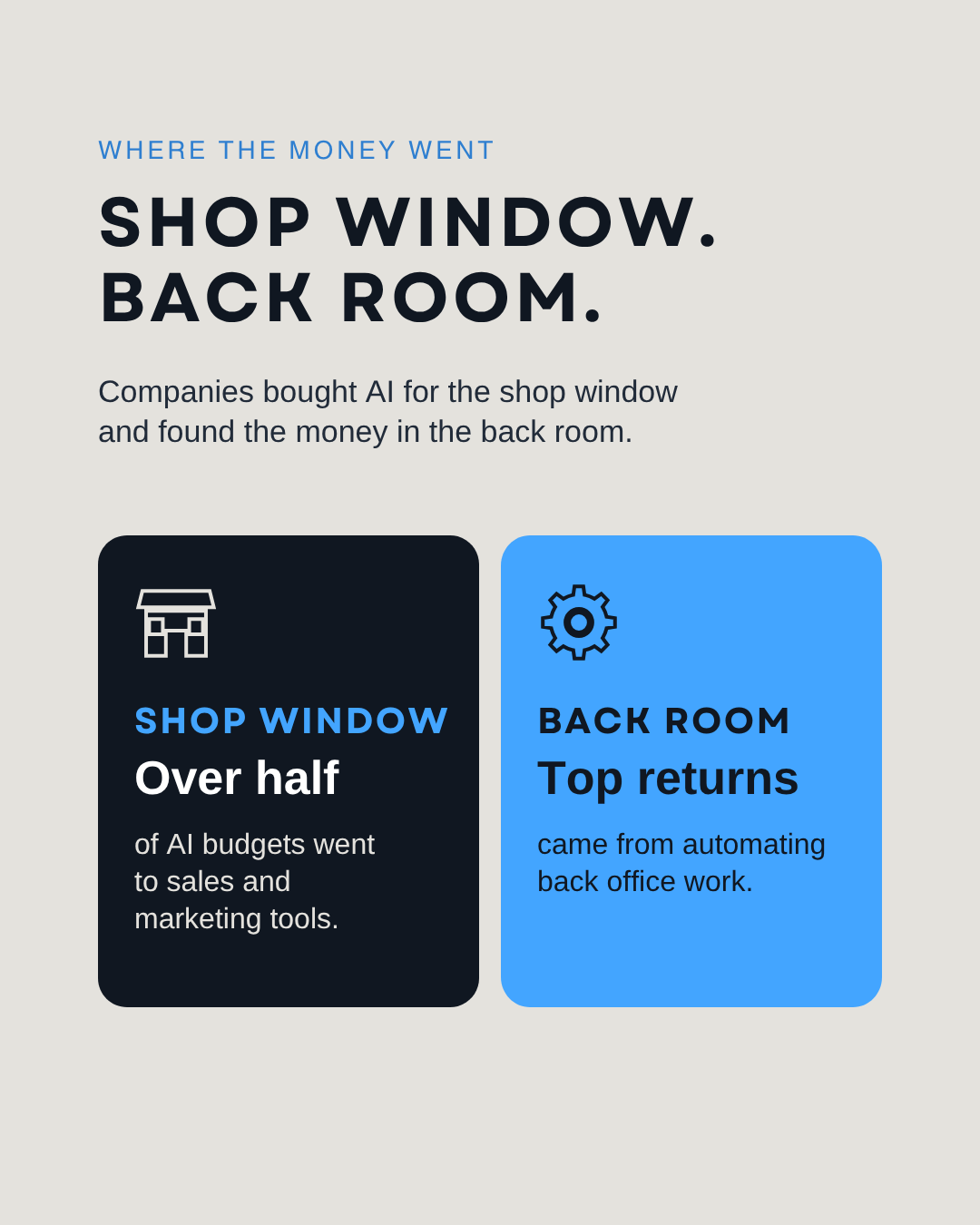
The same report found that more than half of generative AI budgets went to sales and marketing tools, while the biggest returns came from back office automation. Companies bought AI for the shop window and found the money in the back room.
Small businesses are still early. In the U.S. Census Bureau’s Business Trends and Outlook Survey, 17% to 20% of businesses used AI between December 2025 and May 2026, and fewer than 20% of firms with 1 to 4 employees did. Picking the right first task still gives you a head start.
Where does AI save time in a small business?
On tasks that repeat, follow the same steps and get checked before they reach a customer:
- First drafts of quotes, proposals and follow up emails.
- Appointment reminders and confirmations.
- Sorting and summarizing customer messages and reviews.
- Turning meeting notes or voice memos into a to do list.
- Data entry: invoices, receipts and order details.
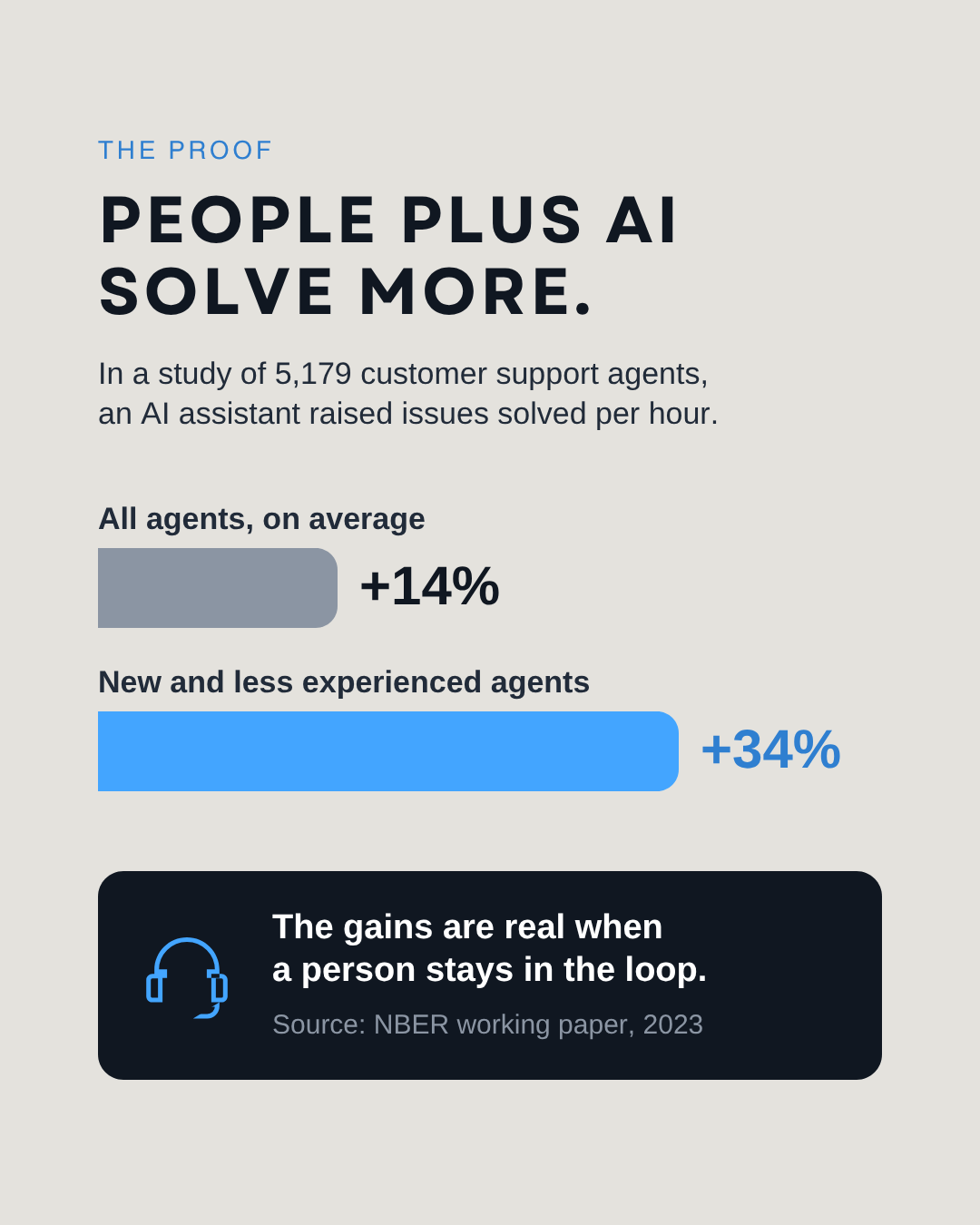
The gains are real when a person stays in the loop. In a study of 5,179 customer support agents, an AI assistant raised the number of issues solved per hour by 14% on average, and by 34% for new and less experienced agents (NBER, 2023).
Where does AI cost you more than it saves?
On tasks where a mistake is expensive, or where customers are paying for you:
- Final prices, legal or medical answers, and anything you promise in writing.
- Your brand voice, when posts go out of a tool with no editing.
- Complaints and sensitive conversations.
- Decisions about strategy, hiring or which offer to sell.
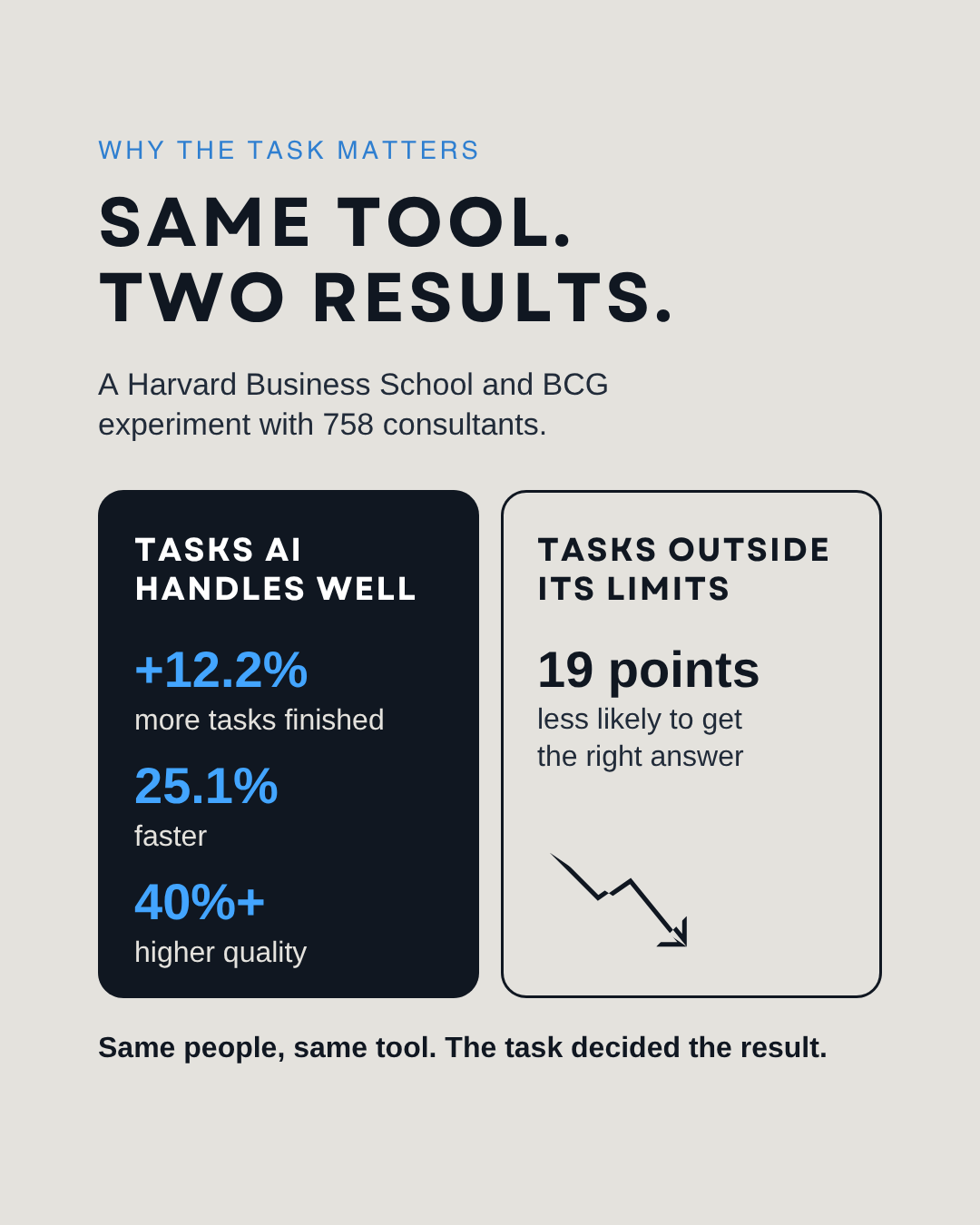
A Harvard Business School and Boston Consulting Group experiment with 758 consultants shows both sides. On tasks AI handles well, consultants using it finished 12.2% more tasks, 25.1% faster, with more than 40% higher quality. On a task outside what AI handles well, they were 19 percentage points less likely to get the right answer than consultants working without it. Same people, same tool. The task decided the result.
How do you choose the first task to give AI?
Pick one task that is frequent, boring and easy to check, then measure it:
- List the tasks you or your team do every week.
- Circle the ones that follow the same steps each time.
- Pick the one that takes the most hours.
- Write down how long it takes today.
- Run it with an AI tool for two weeks and check every result.
- Compare the time, then keep it, fix it or drop it.
Buying usually beats building. In the MIT report, tools bought from specialized vendors succeeded about 67% of the time, against about 33% for tools built in house.
What do we do at 33 Genesis Road?
We put AI on repetitive back office work first: drafts, summaries, reminders and reporting. The client’s voice, offers and final decisions stay human, and a person checks everything before it goes out.
A bakery doesn’t need AI to write its posts. It needs AI to answer “Are you open Sunday?” at 11 p.m. and to turn the week’s orders into a shopping list.
FAQ
Is AI worth it for a small business?
Yes, when it takes over a task you do every week and a person checks the result. Start with one task, measure the time saved, then decide.
What is the best first AI task for a small business?
A repetitive task with clear rules, like follow up emails, appointment reminders or summarizing customer messages.
Should a small business build its own AI tool?
Usually not at first. In MIT’s 2025 report, bought tools succeeded about twice as often as tools built in house.
Can AI write all my social media posts?
It can draft them. Edit every post so it sounds like you, and keep the final say on offers and prices.
Get a second pair of eyes
Not sure where AI fits in your business? At 33 Genesis Road, we offer a free audit of your business, delivered in less than 24 hours. Request it on our free audit page, or message us on LinkedIn or Instagram. For one lesson like this every week, join our free weekly newsletter. See how we work on our services page.
Sources: MIT NANDA, The GenAI Divide: State of AI in Business 2025, as reported by Fortune (August 18, 2025); U.S. Census Bureau, Business Trends and Outlook Survey story (May 26, 2026); Brynjolfsson, Li and Raymond, Generative AI at Work, NBER working paper 31161 (2023); Dell’Acqua et al., Navigating the Jagged Technological Frontier, Harvard Business School working paper (September 22, 2023).