Does the “act as an expert” prompt work? Not for accuracy. Wharton researchers told six AI models they were world class experts and found no reliable gain on hard factual questions. What changes the answer is what you give the AI: who your customer is, what you sell, an example of good work, and the format you want.
Does telling AI to act as an expert make it smarter?
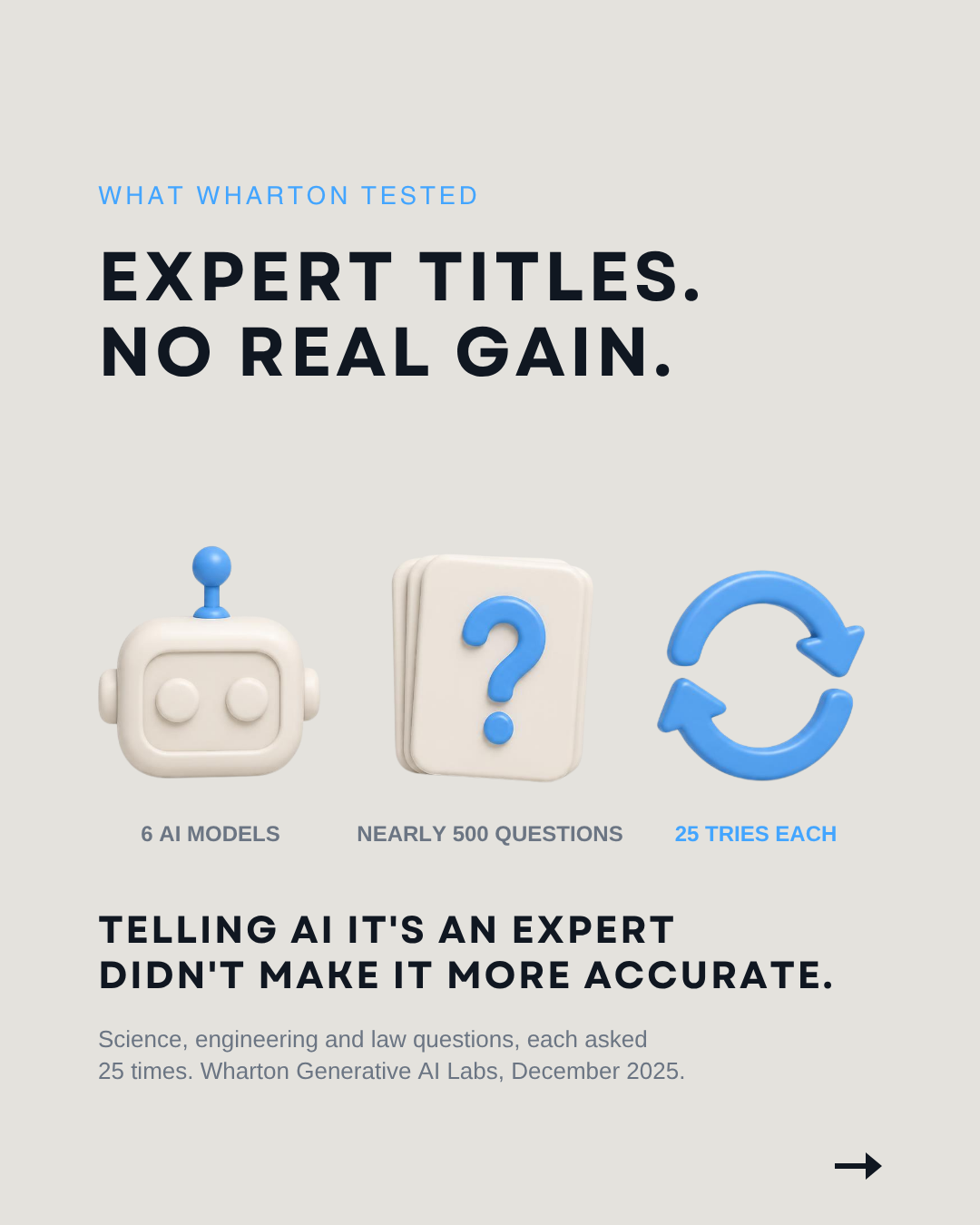
No. In a December 2025 report, Wharton’s Generative AI Labs gave six models from OpenAI and Google expert personas, then tested them on nearly 500 hard multiple choice questions in science, engineering and law. Matching experts produced no reliable accuracy gain over a plain prompt.
Each question was asked 25 times per model and prompt. The personas looked like the ones people paste every day, telling the model it was a world class expert in physics, for example. The details matter:
- One model, Gemini 2.0 Flash, gained modestly with expert personas on one test set. The authors call it a quirk of that model.
- Low knowledge personas, such as a layperson or a toddler, often lowered accuracy.
- An expert from an unrelated field made Gemini 2.5 Flash refuse to answer science questions about 10 times out of 25, on average.
The tests used multiple choice questions, and the authors note personas may still change tone. Their advice to organizations: put the effort into instructions written for the task, examples, and ways to check the output.
What makes a good prompt?
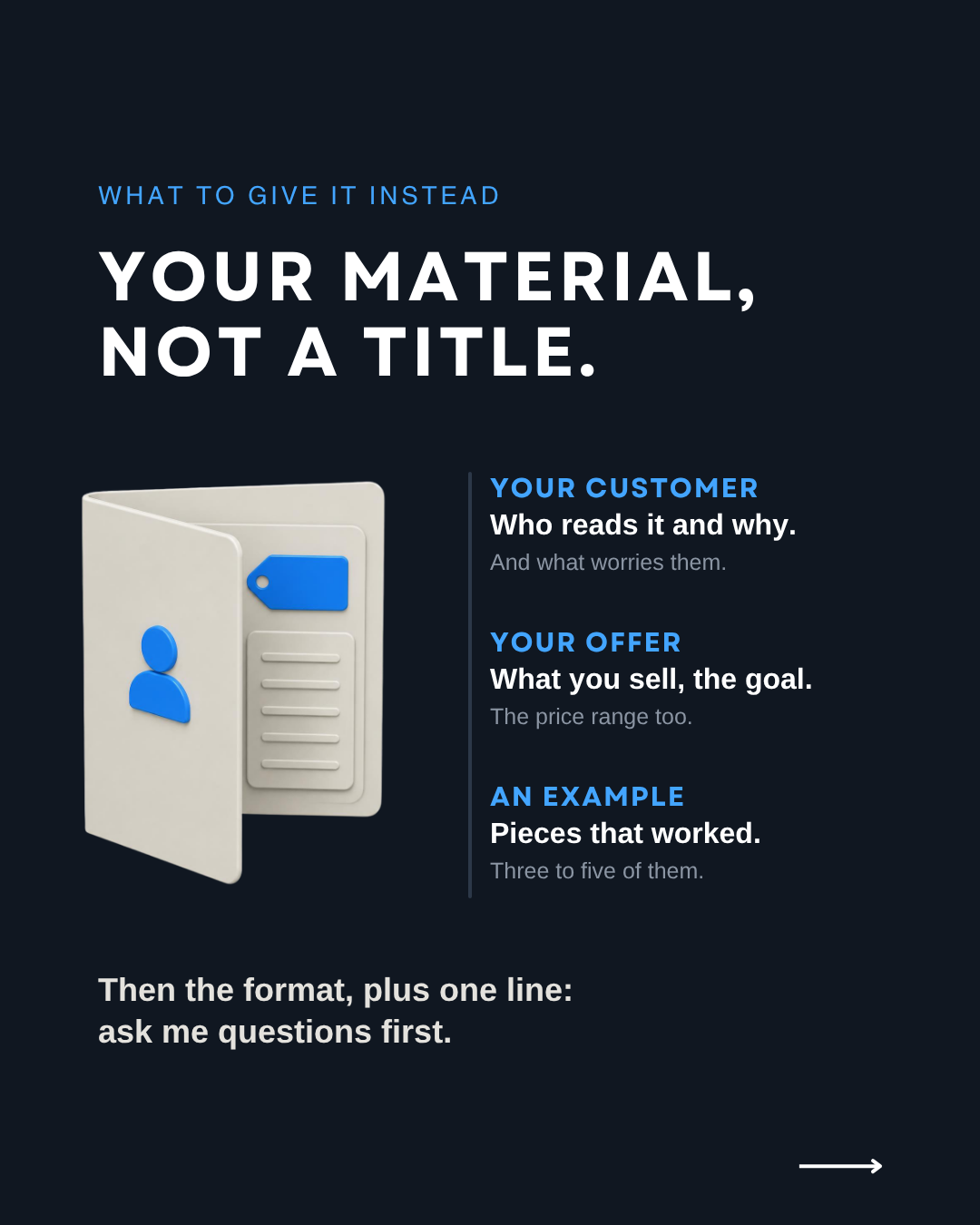
Context, an example and a format. Anthropic’s guide says to treat Claude like “a brilliant but new employee who lacks context on your norms and workflows.” OpenAI asks for detail about the “context, outcome, length, format, style.” Google recommends adding examples to every prompt. Three companies, one message: give the AI your material.
Here’s a simple structure you can reuse:
- Your customer. Who reads this, what they want, what worries them.
- Your offer. What you sell, the price range, and what this piece must achieve.
- An example. Paste pieces that worked, so the AI sees what good looks like.
- The format. Length, tone, and whether you want bullet points or full sentences.
- Questions first. Ask the AI to check what’s missing before it writes.
How do I get AI to write in my voice?
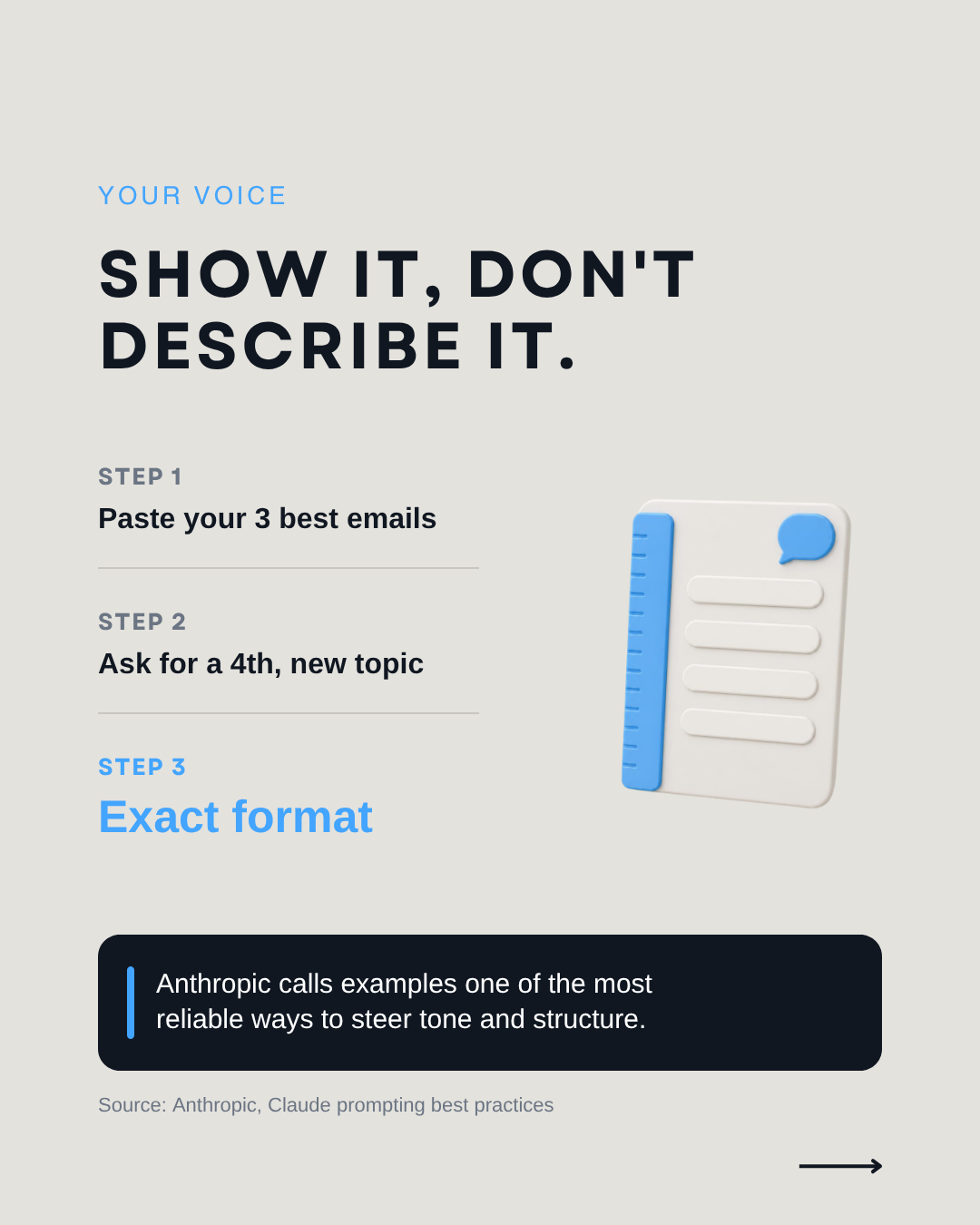
Show it your writing instead of describing it. Paste your three best emails and ask for a fourth in the same style, on a new topic. Anthropic calls examples “one of the most reliable ways to steer Claude’s output format, tone, and structure,” and suggests three to five of them.
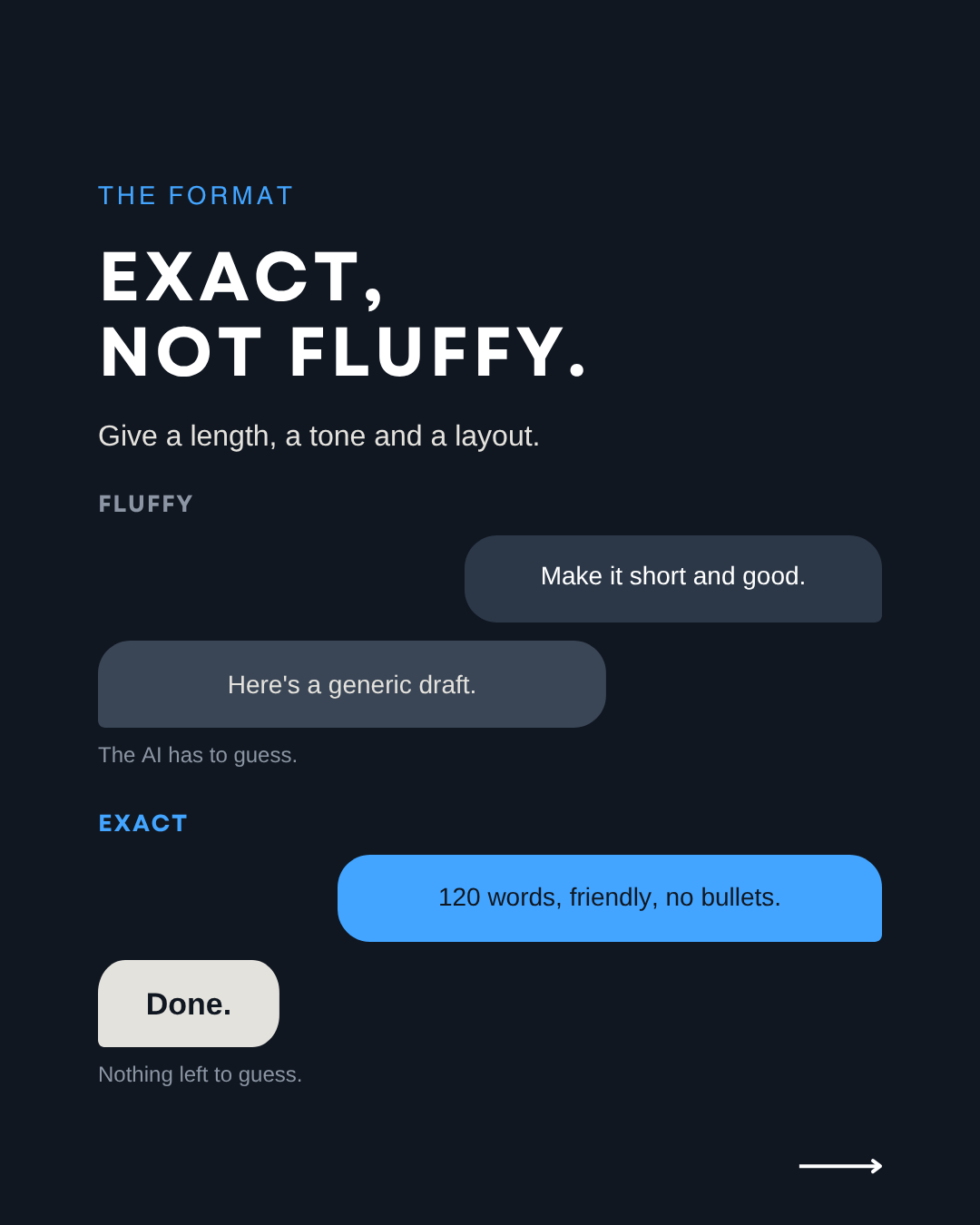
Then spell out the format. OpenAI’s guide warns against “fluffy” descriptions: instead of “fairly short,” give an exact length. Write “120 words, friendly but direct, no bullet points, end with one question,” not “make it good.” OpenAI and Anthropic both suggest saying what to do rather than what not to do.
Should you let the AI ask you questions first?
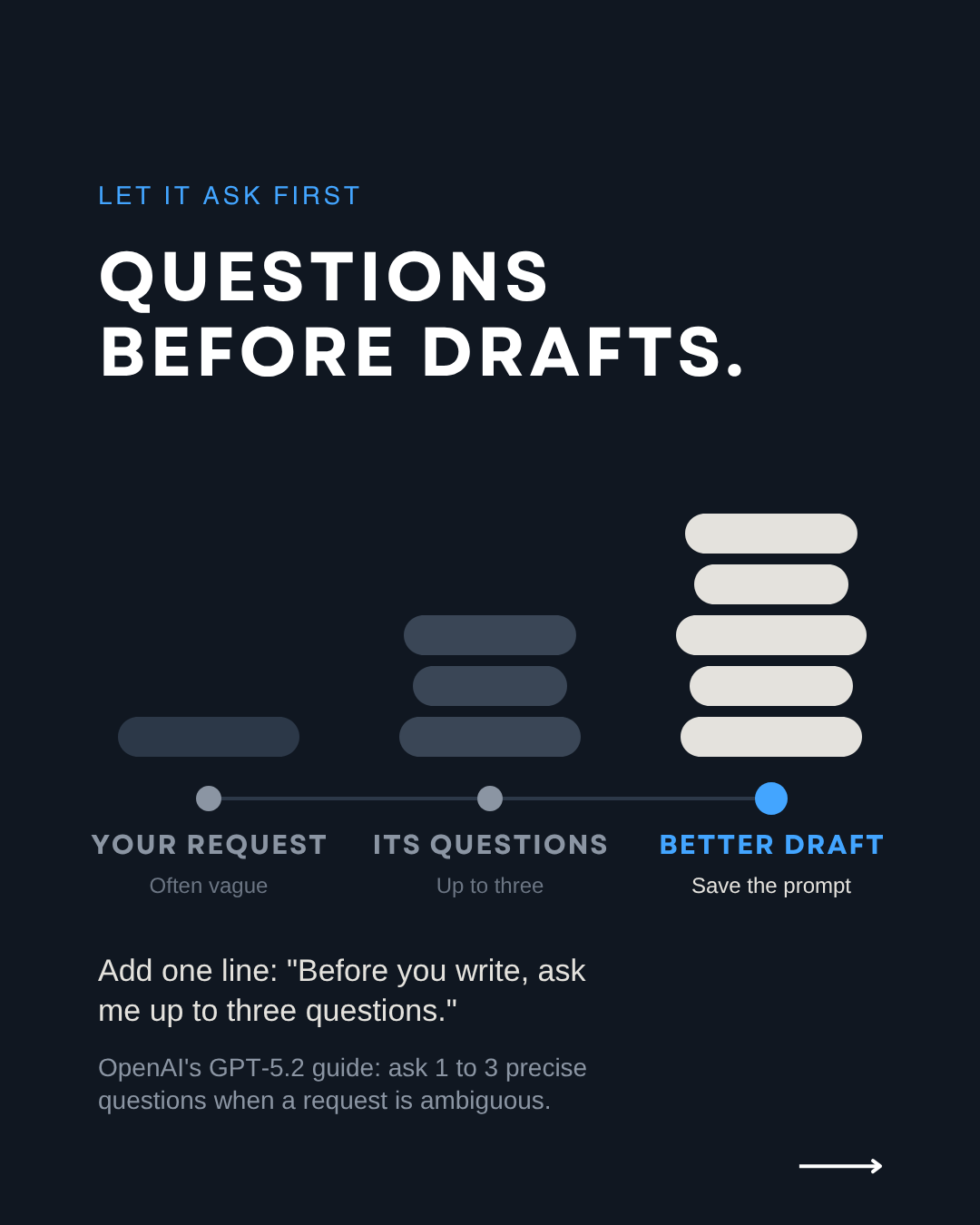
Yes, especially when your request is vague. Add one line to your prompt: “Before you write, ask me up to three questions about anything you need.” OpenAI’s GPT-5.2 prompting guide tells the model to ask one to three precise clarifying questions when a request is ambiguous.
The questions tend to surface what you forgot to say: the audience, the goal, the deadline. Answer them once, save the full prompt, and reuse it next time.
What do we do at 33 Genesis Road?
Here’s what we do: before we write a prompt for a client, we gather the material first: a customer profile, the offer, three examples of past work they liked, and the format each channel needs. The prompt itself stays short. The context does the work.
Want us to look at how your team uses AI? Get a free audit, in less than 24 hours.
FAQ
Does role prompting ever help?
It can shape tone and focus. Anthropic’s guide says a role in the system prompt “focuses Claude’s behavior and tone for your use case.” The Wharton tests found no reliable accuracy gain from expert roles.
What is a good prompt structure?
Customer, offer and goal first, then an example of good output, then the format: length, tone and layout. End by asking the AI to raise questions before it starts.
Do these tips work in ChatGPT, Claude and Gemini?
The basics carry over. OpenAI, Anthropic and Google each recommend clear context, examples of good output and a stated format in their own guides.
Can an expert persona make AI worse?
Sometimes. In the Wharton report, low knowledge personas often lowered accuracy, and an unrelated expert role made one Gemini model refuse to answer often.
Sources: Wharton Generative AI Labs, Prompting Science Report 4: Playing Pretend: Expert Personas Don’t Improve Factual Accuracy (December 5, 2025); Anthropic, Prompting best practices, Claude Platform Docs (2026); OpenAI, Best practices for prompt engineering with the OpenAI API (2026); Google, Prompt design strategies, Gemini API (October 13, 2026); OpenAI, GPT-5.2 Prompting Guide (December 11, 2025)